From the grand Mahakumbh in January to the tragic Pahalgam terror attack, and later the tense escalation with Pakistan – all unfolding alongside high-stakes Delhi and Bihar elections- 2025 was a year that rarely paused for breath.
Amid this constant churn of news and breaking updates, misinformation quietly found its sweet spot. Misleading posts and alarmist claims flooded social media, spreading faster than verified facts and shaping public opinion before the truth could catch up.
So, as we look back, how exactly did misinformation evolve through 2025? And what key trends stood out in this fast-moving information landscape?
What We Analysed: Over 3,100 Claims Across India in 2025 (Jan 1- Dec 15, 2025)
Between 1 January and 15 December 2025, Newschecker analysed more than 3,100 claims, each one a distinct piece of content or narrative that was individually fact-checked. These fact checks spanned ten languages – Hindi, English, Tamil, Malayalam, Kannada, Marathi, Bengali, Punjabi, Urdu and Gujarati – highlighting how misinformation travelled across India’s varied linguistic and cultural landscape.
For every claim, key details were recorded: the language, category or subject, related event, target of the claim, type of media involved, and the final verdict. We also tracked whether the claim showed gender bias, targeted individuals from SC/ST communities, carried communal undertones, or contained elements created or altered using AI.
To map how claims were connected, we grouped related ones under shared events – whether a common incident, location, decision, or situation – and each grouping was reviewed by editors to ensure accuracy.
All this work was powered by Newschecker’s custom-built data tool, designed to collect and analyse information from every fact check efficiently and systematically.
And here’s what the numbers revealed…
Political Misinformation Dominates Trends
Over 30% of the claims fact-checked by Newschecker during this period were political in nature, while about 17% dealt with nation-related issues, including the India-Pakistan escalation. Together, these themes show how heavily misinformation latched onto high-stakes governance and national security debates in 2025.
India-Pakistan Stand-off: Biggest Flashpoint
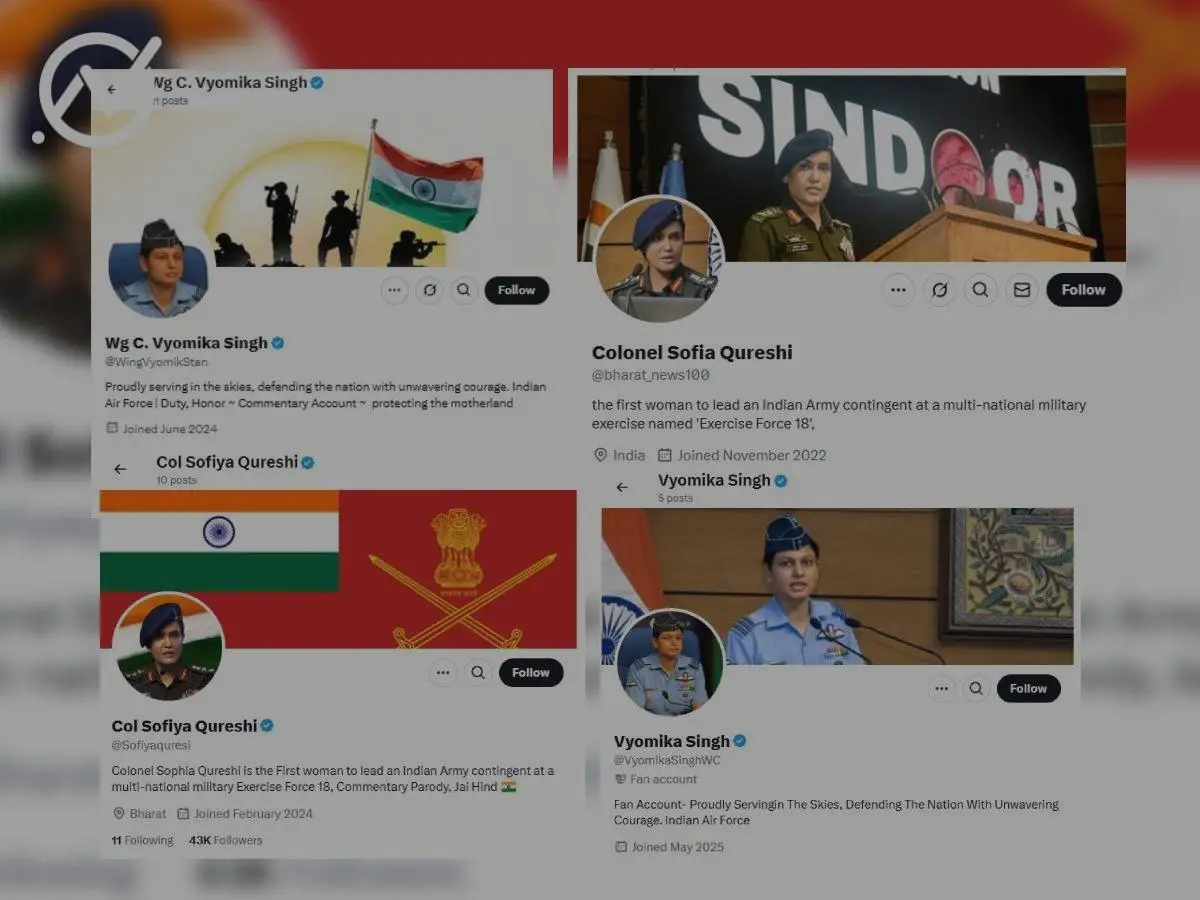
The India–Pakistan stand-off emerged as the single biggest misinformation flashpoint of the year, accounting for roughly 9% of all claims checked by Newschecker. Old and recycled visuals claiming Indian military setbacks went viral, with several Pakistan-based accounts even posing as Indian social media users to spread narratives of large-scale Indian casualties.
False Visuals And AI-Made Clips
Misleading content around the stand-off was often supercharged by visuals, including video-game footage and AI–generated media passed off as real videos of Indian jets being shot down by Pakistan. Such fabricated media not only blurred the line between fact and fiction but also made it harder for ordinary users to assess the real situation on the ground.
When Misreporting Fuels Misinformation
Beyond online rumours, the stand-off also exposed gaps in mainstream news coverage, where instances of misreporting raised fresh questions about the credibility of Indian media. Sensational war-room style debates and theatrical coverage helped create a mood of alarm and speculation, making it easier for misinformation to spread.
Newschecker’s trend analysis shows that over 4% of all claims analysed in 2025 were amplified by mainstream media itself, indicating how legacy platforms can become force multipliers for false or misleading narratives.
AI-Driven Misinformation Takes Centre Stage
The use of AI in misinformation around the stand-off was extensive, with deepfake-style videos of EAM Jaishankar, CDS and the Chiefs of, Army, Air Force and Navy, falsely showing them admitting to heavy Indian casualties, circulating even months after the May ceasefire. These fabricated clips kept the tension alive online long after the guns had fallen silent.
Nearly 24% of all claims related to the India-Pakistan escalation contained media that was either generated or edited using AI, a sharp spike compared to the annual average, where AI-assisted content made up about 18% of all claims fact-checked by Newschecker in 2025. This jump underlines how quickly AI tools are moving from the margins to the heart of India’s misinformation ecosystem.
Verified, Yet Misleading: Blue-Tick Effect
The stand-off also underscored how verified accounts continue to play a major role in pushing misinformation, lending it an added layer of perceived credibility. Nearly 45% of the accounts that shared false or misleading content about the India-Pakistan stand-off were verified, showing that the “blue tick” is no guarantee of accuracy.
This pattern mirrors the broader yearly picture: across 2025, about 39% of all claims fact-checked by Newschecker originated from verified pages or profiles. In other words, some of the loudest and/or most trusted voices online were also among the most active vectors of misleading information.
Campaigns to Results, Misinformation Thrived Around Polls
The year also saw two of the most bitterly fought contests in recent memory – the Delhi and Bihar elections – and misinformation tracked every phase, from campaign rallies to counting day. Both races turned into fertile ground for false claims, polarising narratives and targeted attacks on key political figures.
In Delhi, misleading content ranged from fake opinion polls to a forged letter attributed to Arvind Kejriwal, falsely claiming he had sought special facilities for Muslim voters. These narratives gained traction ahead of voting, feeding into existing political and communal anxieties.
Women Leaders in the Line of Fire
The selection of Rekha Gupta as Delhi’s Chief Minister triggered a spike in gendered misinformation, sharply increasing the share of claims targeting women to 21% in the immediate post-result period, compared to 13% for the whole of 2025. From posts alleging she spent crores on a new luxury car to miscaptioned clips falsely identifying a woman practising sword fighting as her, the new CM remained at the centre of misinformation for weeks after the results.
Bihar: Fraud Claims & Viral Attacks
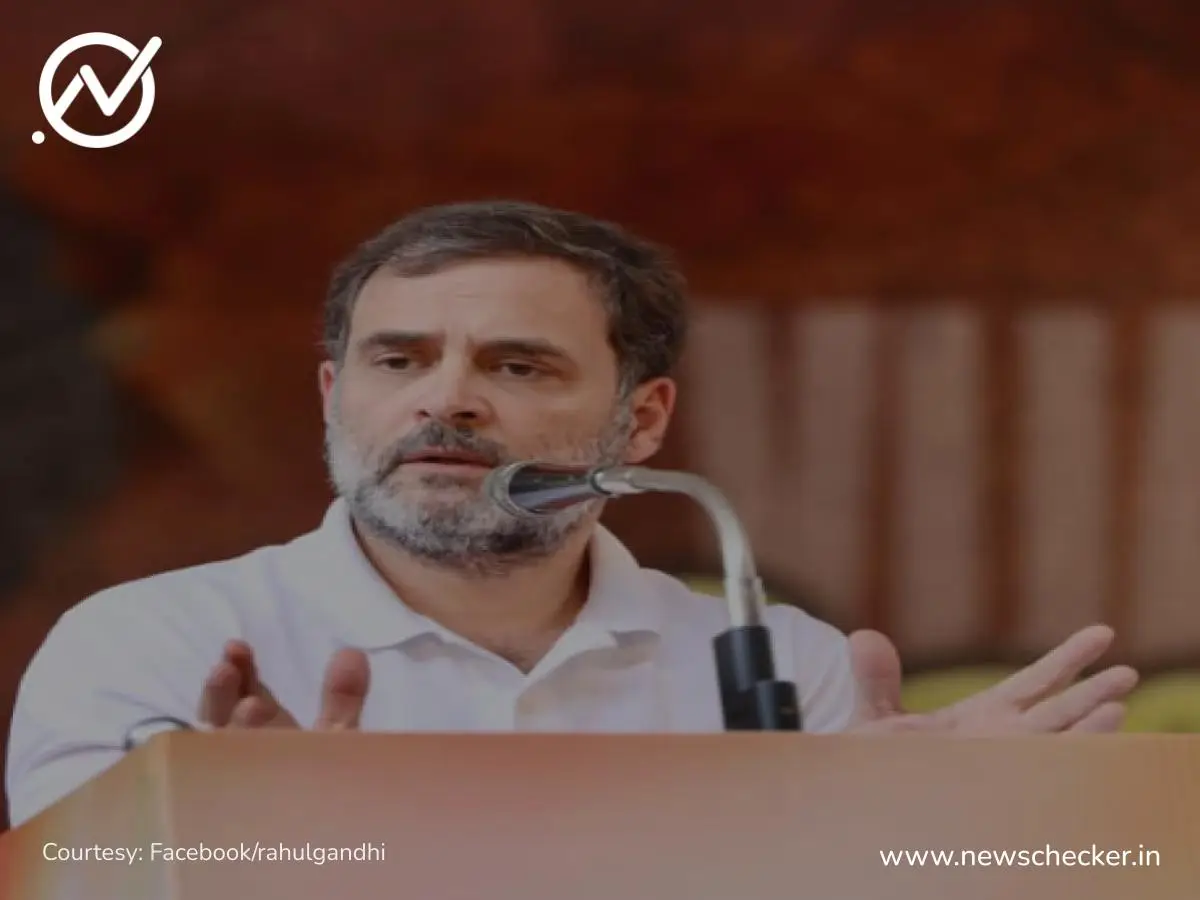
In Bihar, voter fraud allegations by Rahul Gandhi injected fresh intensity into an already high-voltage campaign, quickly dominating the political conversation. The claims sparked a wave of misleading posts targeting the Prime Minister and the Chief Election Commissioner, while Gandhi’s subsequent Voter Adhikar Yatra became another magnet for misinformation.
Beyond individual leaders, other viral narratives focused on alleged governance failures under Nitish Kumar, backlash against the BJP over its Operation Sindoor campaign, and even a doctored image showing Rahul Gandhi’s face printed on sanitary pads. Together, these episodes show how elections in 2025 became a testing ground for increasingly aggressive and visual misinformation.
Disaster to Devotion: Misinformation Finds Opportunity
Beyond politics, misinformation thrived during moments of collective grief and faith – from the Air India Plane Crash in Ahmedabad to the Prayagraj Mahakumbh. Such large-scale tragedies and mass gatherings created perfect conditions for false information to circulate rapidly, as people searched for updates, visuals, and explanations in real time.
In the hours following the Ahmedabad plane crash, social media saw a surge of unverified and misleading posts, manycapitalising on the initial confusion and absence of official details. Among the most viral were supposedly “last photos” of former Gujarat Chief Minister Vijay Rupani from inside the flight, and unrelated images falsely presented as members of the cabin crew who had perished in the crash.
Viral misinformation surrounded the Mahakumbh 2025 event, particularly involving AI-generated images and unrelated media falsely linked to the festival. (1, 2, 3,4, 5, 6, 7, 8) A stampede incident further fuelled false claims, including fabricated predictions and arrest narratives.
AI Celebrity Images Floods Social Media Timelines
AI-generated photos depicted celebrities like Shah Rukh Khan, Salman Khan, Dwayne Johnson, and even US President Donald Trump taking ritual dips at the Mahakumbh in Prayagraj. Similar fakes targeted Indian actors like Ajay Devgn, Preity Zinta, and Prakash Raj, who publicly denounced them.
Misinformation Around Stampede
Following the January 29 stampede that killed at least 15 people, an AI-generated letter falsely attributed a prediction to godman Dhirendra Shastri went viral. Other posts shared AI images claiming a terrorist disguised as a monk named Ayub Khan was arrested, though police detained a man named Ayub Ali without criminal links. Old videos of politicians and celebrities at prior events were repurposed to mislead audiences about the incident.
Communal Claims: A Persistent and Dangerous Trend
Communal claims also figured in the host of claims relating to Mahakumbh. One of them, which saw traction across languages, claimed to show a video of police thrashing some men for throwing stones at a train going to Mahakumbh (the stone pelting claim a common disinformation plot to target Muslims). Another claimed that a Muslim youth was arrested for peeing on a Mahakumbh poster, while another claim said that a terrorist was arrested for disguising himself as a monk at the Mahakumbh. Communal claims were not just restricted to Mahakumbh. Of the total claims debunked in 2025, a total of 15% of them were found to be communal. Of these, over 70% of the communal claims were found to target the Muslim community.
Communal Claims During Mahakumbh
Communal misinformation surged around the Mahakumbh 2025, exploiting religious tensions through recycled tropes like stone-pelting and disguised terrorists often amplified by AI visuals and old footage. Communal claims accounted for 15% of all debunked claims in 2025, with over 70% targeting Muslims. These claims spread rapidly across Hindi, English, and regional languages on platforms like WhatsApp and X (formerly Twitter). This mirrors patterns from prior events like the 2019 Kumbh, where similar plots fueled violence. Authorities issued warnings, but rapid sharing outpaced corrections.
Key False Narratives Around Kumbh
Stone-Pelting Video: A widely shared clip claimed police beat Muslims for throwing stones at a train carrying pilgrims to Prayagraj. Fact-checks revealed it originated from a 2023 incident in Bihar unrelated to Mahakumbh, repurposed to incite anti-Muslim sentiment.
Urine on Poster Arrest: Posts alleged a Muslim youth was arrested for urinating on a Mahakumbh poster. No such incident occurred; the claim stemmed from an old, unrelated video from 2022 in Uttar Pradesh.
Terrorist Monk: An AI-generated image of a man named “Ayub Khan” dressed as a sadhu claimed he was arrested as a terrorist. Police clarified they detained Ayub Ali for minor theft, with no terror links; the image was fabricated.
International Events Fuelling Misinformation
Newschecker’s 2025 analysis showed 17% of fact-checked claims tied to global events, with conflicts and protests sparking waves of false narratives. The Israel-Iran conflict, US strikes on Iran, Nepal’s Gen Z protests, and LA wildfires drew heavy misinformation, often amplified by Indian media and social platforms.
Israel-Iran Conflict and US Involvement
Tensions escalated in mid-2025 with Israeli strikes on Iranian targets, followed by US bombings. Misinformation included recycled footage of explosions from Russia and Syria passed off as live Iran attacks, alongside fake casualty lists targeting specific ethnic groups.
Nepal Gen Z Protests
Nepal’s youth-led protests against government corruption in late 2025 prompted rampant falsehoods. Indian outlets falsely reported the ex-PM’s wife died in an arson attack on her home – actually a mix-up with a 2024 Kathmandu fire unrelated to protests.
Social media buzzed with old videos: clips from 2023 Pakistan riots and 2022 Indonesian clashes repurposed as “Nepal chaos,” fueling cross-border panic.
LA Wildfires
The massive LA fires in summer 2025 saw old California blaze videos recirculated as “current infernos,” paired with bogus claims of arson by immigrants.
Countries Under the Lens: Who Faced the Most Misinformation
An analysis of the claims fact checked by Newschecker in 2025 revealed that India led the pack as the top target of misinformation in 2025, enduring intense campaigns and propaganda amid -and long after- the India-Pakistan escalation. Pakistan ranked a close second, facing its own barrage of false narratives. Israel and Iran, locked in their own high-stakes standoff earlier this year, rounded out the list of the most targeted nations.
Parties, Leaders & State Govts: Stage Set for 2026 TN Polls
Misinformation in 2025 zeroed in on political powerhouses – individual leaders, parties, and state governments- amid rising tensions. Newschecker’s analysis found Prime Minister Narendra Modi, Rahul Gandhi, and TVK chief Vijay as top targets. While Modi and Gandhi remain perennial favourites for false narratives, Vijay’s sudden rise signals shifting battlegrounds.
This pattern intensifies around Tamil Nadu’s 2026 Assembly elections. The DMK-led state government faced the heaviest misinformation barrage among all state governments, with Chief Minister MK Stalin ranking fifth overall – trailing just behind Union Home Minister Amit Shah. Uttar Pradesh and Punjab administrations also drew fire, alongside Bihar’s JDU-led NDA coalition.
Targeted Parties
Political parties faced similar assaults, with the BJP leading the list, followed by the DMK and the AIADMK. Trinamool Congress and Aam Aadmi Party rounded out the top five, reflecting fierce online narrative wars as polls loom.
The Many Shades of Misinformation
While most of the claims fact-checked by Newschecker in 2025 were entirely false, a sizeable share fell into murkier territory – content built around edited visuals or selective truths presented as fact. Roughly 9% of claims missed key contextual details, and another 9% were only partly true, yet both were shared to intentionally mislead. These patterns reveal a clear shift: misinformation today increasingly trades in nuance, using visual manipulation and partial truths more than outright fabrications.
Visuals First: How Misinformation Is Packaged
When it came to format, misinformation in 2025 was overwhelmingly visual. In at least 42% of the cases, false or misleading claims appeared as videos with overlaid text, while another 27% were videos shared without any added text. Together, that means nearly seven out of every ten claims took a video form- confirming that moving images remain the fastest-spreading medium for falsehoods. Images paired with text made up about 20% of the total, and standalone photos accounted for just 7%, showing that motion and visual storytelling have become core tools of misinformation.
Hindi and English Lead, Regional Languages Follow
Across languages, Hindi (23%) and English (22%) dominated the misinformation landscape -together making up almost half of all claims debunked by Newschecker in 2025. However, regional languages continued to carry significant weight: Tamil (13%), Bangla (9%), and Punjabi (7%) featured prominently among the rest.